
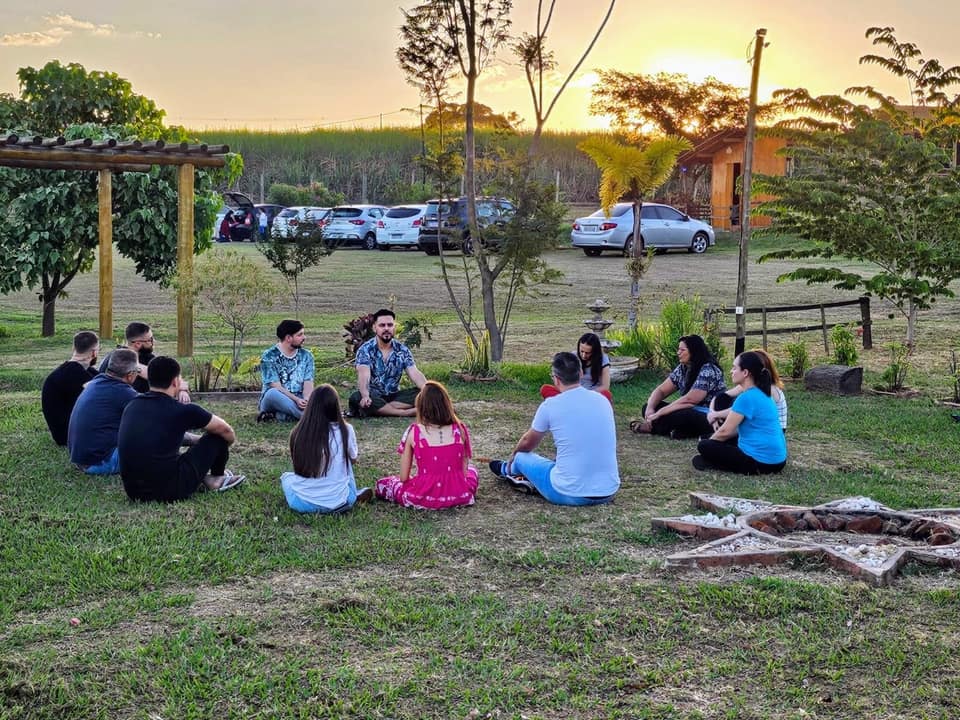
The meaning of service
Volunteering and guardianship are commitments, not titles.
Volunteer service at the Sanctuary is freely chosen, unpaid and formalized through a written agreement. It does not create an employment relationship and follows Brazil’s Volunteer Service Law, Law No. 9,608/1998.
A guardian is a prepared volunteer who supports activities and helps care for the space and the people taking part. The role does not give anyone spiritual authority over others, control over the organization or a place for personal promotion.
Expressing interest does not lead to an immediate appointment. The path depends on participation in the community, preparation, trust, availability, the needs of the house and a conversation with the leadership. No one needs to volunteer in order to belong to the community or attend ceremonies.
A path of preparation
How someone becomes a volunteer and guardian
1. Know the community
Attend the Sanctuary regularly, understand its guidelines and observe how the community welcomes people and prepares each gathering.
2. Speak with the leadership
Share your interest and discuss motivation, availability, personal limits and areas where your collaboration may be useful.
3. Take part in formation
Receive guidance and, when invited, attend meetings, preparations and internal ceremonies that are not listed on the public calendar.
4. Serve with supervision
Begin with defined tasks, learn the Sanctuary’s procedures and demonstrate discretion, balance, reliability and teamwork.
5. Formalize the commitment
After assessment, sign the Volunteer Service Agreement. Signing does not replace continued formation or make the guardian role permanent.
Where service happens
Caring for a ceremony includes everything around it.
- Prepare the hall, altar, lighting, materials and welcoming area before ceremonies.
- Collaborate in public ceremonies and, when authorized, internal activities and ceremonies.
- Welcome and orient participants according to the responsibilities assigned by the leadership team.
- Notice special or emergency needs and immediately call the responsible director rather than acting beyond one’s role.
- Care for cleaning, gardens, decoration, maintenance and the proper return of materials and equipment.
- Help reorganize and close the space after gatherings.
- Attend formation, integration, assessment and team-alignment meetings.
Expected conduct
Those who serve must know when to listen, act and step back.
Guardians need to be punctual, attend regularly, communicate honestly and be willing to follow guidance. Whenever possible, a volunteer who cannot attend should notify the Presidency at least 48 hours in advance.
Everything personal heard or seen during service is confidential. Stories, personal data and situations involving participants must not be shared, published or used for personal benefit. Everyone is treated with dignity, without discrimination based on race, color, gender, sexual orientation, religion, age, disability or any other condition.
Volunteers must care for their own health and disclose any condition, medication or circumstance that may affect attention, safety or judgment. No one may serve while impaired by illicit substances or in any condition incompatible with attentive care.
Limits of the role
A guardian supports without diagnosing, prescribing or taking over another person’s experience.
Guardians offer presence and practical help within the guidance they have received. They do not interpret someone else’s experience, promise healing, tell anyone to stop medication, prescribe what to do or replace medical, psychological or emergency care.
When discomfort, conflict or risk goes beyond a simple task, the guardian should protect the space and call a director. Knowing when to ask for help is part of serving safely.
Sacramental medicines and other ritual elements require deep respect. Handling, serving and storage are restricted to duties expressly assigned by the leadership team.
Pausing or ending service
There are times to serve and times to receive care.
A volunteer may end their service at any time, preferably with prior notice. The Sanctuary may also pause or end the relationship when continued service is no longer safe, appropriate or consistent with its guidelines.
More than two unjustified absences — beginning with the third — may lead to termination. Breaches of confidentiality, safety, respect, schedules or assigned responsibilities may also result in removal, as may misuse of the role or a significant loss of trust.
If someone is going through a more vulnerable period physically, emotionally or spiritually, the leadership may suggest a pause or close that cycle of service. This is not a diagnosis, punishment or exclusion from the community. Sometimes receiving support and caring for oneself is the most responsible choice.
Whenever safety allows, the decision is discussed openly. An urgent situation may require the person to step away immediately. A future return begins with a new conversation and is not automatic.
Before expressing interest
Questions for an honest decision
- Can I reliably commit to tasks before, during and after ceremonies?
- Am I willing to do simple, discreet and often unseen work such as cleaning and organizing?
- Can I protect confidentiality without turning service into status or authority?
- Can I receive guidance, correction and continuing assessment?
- Does my present condition allow me to care for others without neglecting my own care?
- Am I available for formation, meetings and internal activities when invited?
First contact
Would you like to discuss the volunteering path?
If you already know the Sanctuary, take part in the community and feel a sincere wish to serve, speak with the leadership team. Tell us briefly how long you have attended, why you would like to help and when you are available.
This message simply starts a conversation. It is not an automatic enrollment or appointment as a guardian.
Essential information
Do I need prior experience to volunteer?
No technical background is required. You do need to know the Sanctuary, attend regularly, act responsibly and take part in its own formation process. Experience elsewhere does not replace this path.
Can I volunteer without becoming a guardian?
Yes. People may help with gardens, cleaning, conservation, organization and other community needs. Guardianship involves additional responsibilities during activities and requires further preparation and trust.
Is volunteer service paid?
No. The service is unpaid and does not create an employment relationship. An expense may be reimbursed only when expressly authorized by the organization, in accordance with the law and the signed agreement.
What if I need to step away?
Speak with the leadership team as soon as possible. A responsible pause is better than maintaining a commitment that cannot be fulfilled. Either party may end the relationship, and a future return may be considered through a new conversation.
Institutional content prepared by Santuário Céu de Aparecida and reviewed by Michael Luis Miguel Pereira e Bruno Lucas de Paula Luz · Updated September 1, 2026.
Sources and limits of this content
Sources
- Brazilian Law No. 9,608 of February 18, 1998 — Volunteer Service
- Volunteer Service Agreement of Santuário Céu de Aparecida
- Institutional records concerning the conclusion of volunteer service